The Fatal Flaw The Waterproofing Myth
The biggest misconception about bitumen is that it is a waterproof sealant i.e.. The Fatal Flaw The Waterproofing Myth In reality, bitumen is porous. While it sheds the majority of surface water, it allows moisture to permeate through the matrix.
When applied over concrete, this creates a “trap.” Unlike a breathable concrete sealer, the bitumen layer slows down evaporation. Water becomes locked between the concrete substrate and the bitumen patch, leading to several critical failure points:
1. The “Greenhouse Effect” and Vapor Pressure
When the sun hits that dark bitumen, the surface temperature can easily exceed 50°C to 60°C. Any water trapped underneath begins to heat up and turn into water vapor.
-
Expansion: As liquid turns to gas, it expands significantly.
-
Delamination: This internal vapor pressure pushes upward, physically forcing the bitumen to lift away from the concrete. This is why you often see bitumen patches “bubble” or crack shortly after a hot spell following rain.
2. Concrete Spalling and Internal Erosion
Concrete needs to “breathe.” When moisture is trapped under a non-breathable bitumen layer, it saturates the top layer of the concrete.
-
Surface Softening: Constant moisture weakens the cement paste (the glue holding the rocks together).
-
The Sledgehammer Effect: When cars drive over the bitumen speed bump, the water trapped underneath is pressurized. This “hydrostatic pressure” is forced into the microscopic pores of the concrete, literally blowing the surface of the concrete apart from the inside out.
-
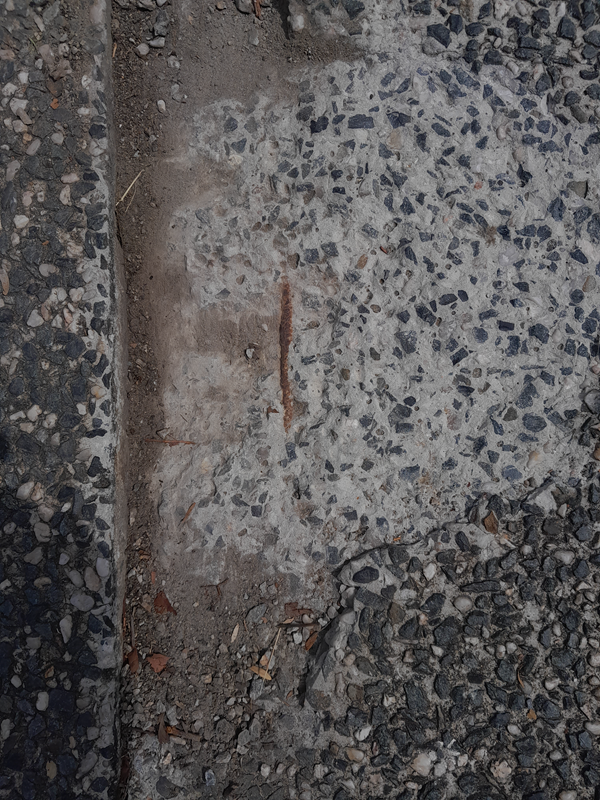
Result: This leads to spalling, where the top 5–10mm of the concrete driveway turns into loose grit and pebbles (as seen in your first image).
Why Bitumen Speed Bumps Fail on Concrete
Looking at the photos of the speed bumps, there are three specific reasons they will degrade rapidly:
-
Adhesion Failure: Bitumen does not chemically bond to concrete. It relies on a mechanical grip. Once water gets under the edge, the bond is broken, and the entire bump can shift or “shove” under the weight of a braking tire.
-
Vegetation Growth: As seen in the third image, cracks in the bitumen allow seeds to take root. The roots seek out the moisture trapped at the concrete interface, further prying the repair apart.
-
Ponding Water: Because these bumps are often hand-formed, they create “dams” that cause water to pond (as seen in the second and third images). This standing water provides a constant supply of moisture to seep into the cracks and under the repair.
- Position of the Speed Bump – Usually installed directly across the road (cause ponding) If installed at a slight angle in the direction of the fall the water drains away more quickly without or at least less ponding which forces more water into the porous cement.
Faulty Bitumen on Roadway
Waterproofing myth fact – Road bitumen is not waterproof.
The Verdict: A Temporary Band-Aid
While bitumen is cheap and easy to apply, using it on concrete is a temporary measure that eventually causes more expensive damage. The loose, spalling concrete underneath the bitumen means that when you eventually do want to fix it properly, you will have to grind away several millimeters of damaged concrete just to reach a solid surface again.
Better Alternatives:
-
For Cracks: Use a dedicated polyurea or epoxy-based concrete crack filler that creates a genuine waterproof bond.
-
For Speed Bumps: Use bolt-down rubber speed bumps. They allow water to flow around them and don't trap moisture against the concrete surface.
-
For Concrete Repair: Use cementitious repair mortars designed to expand and contract at the same rate as your driveway.
Bottom Line: If you see water ponding against a black bitumen patch on your concrete, the countdown to structural spalling has already begun. In this case the bitumen was applied directly to the concrete directly over joints without removing the already spalled sections of the concrete. Consider cementitious and bituminous waterproofing. Bitumen used for speed bumps is not waterproof.
So the The Fatal Flaw The Waterproofing Myth Using Bitumen – https://waterproofingshop.com/the-fatal-flaw-the-waterproofing-myth/ – If you're searching for The Fatal Flaw The Waterproofing Myth Using Bitumen then watch this video to learn everything you need to know about The Fatal Flaw The Waterproofing Myth Using Bitumen

Materials Required to Waterproof and Protect Concrete Driveways
- 5 Benefits of Drizoro Maxrest Passive for Rebar Corrosion Protection
Halts the corrosion to rebar - 11 Benefits SealTight Penetrating Clear Concrete Sealer
Can be used to make the concrete waterproof under your Bitumen Speed Bump - Why Use CMA100 Ultra ClearSeal? – 16 Benefits
Penetrating sealer seals static cracks up to 2.2mm and hardens the concrete to another level - 11 Benefits of Drizoro Maxseal Traffic Flexible Coating
Flexible Trafficable cementitious which won't bubble if water gets below it. Allow transmission of water vapour - 11 Benefits Of Drizoro Maxjoint Elastic Express
Flexible trafficable joint sealant 15% movement – ready for traffic almost immediately - 11 Benefits of Drizoro Maxroad For Pavement Repair
- References
https://en.wikipedia.org/wiki/Speed_bump
https://en.wikipedia.org/wiki/Bitumen
