The “Wet Concrete” Paradox: 5 Surprising Lessons from the Frontlines of Waterproofing
In this article you will learn the 5 Surprising Lessons from the Frontlines of Waterproofing. In my decades of consulting on building maintenance and restoration, I have seen one undisputed king of destruction: water. It is a relentless, unwelcome presence and the primary catalyst for the vast majority of building defects. I’ve walked through countless basements and tunnels where water wasn't just a nuisance; it was a structural predator, slowly eating away at the reinforcement and compromising the investment of the owner. For too long, the industry relied on “patch and pray” methods—surface membranes that acted like a temporary skin, destined to peel.
But modern chemistry has shifted the paradigm. We no longer just apply a layer on top of a problem; we use cementitious technology to transform standard concrete into a high-performance “invisible armor.” By understanding the material science behind the Drizoro range, we can turn the very nature of concrete against the threat of moisture. Here are five lessons from the frontlines that prove why the old way of waterproofing is officially obsolete.
- FORGET THE DRY TIME—WATER IS NOW THE CATALYST
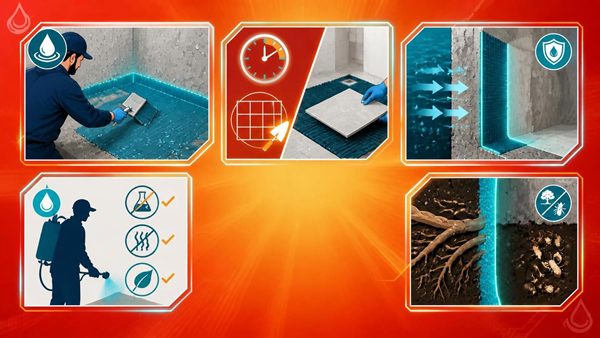
In traditional waterproofing, moisture is the enemy of adhesion. I’ve stood on job sites where work ground to a halt for days because we were waiting for a substrate to be bone-dry. If you apply a traditional membrane to a damp wall, you’re basically guaranteeing a failure. However, Drizoro technology flips this logic on its head. Products like Maxseal Foundation and Maxseal Flex actually require a wet surface to function.
Instead of waiting for the surface to dry, you saturate it. This eliminates the “waiting game,” which is a total game-changer for project timelines. In masonry, you’re often told to wait 28 days for a full cure before waterproofing; here, that rule is history. The water acts as a carrier, allowing the cementitious membrane to penetrate and “lock” into the open pores of the substrate. It doesn't just sit on the surface; it becomes part of the wall.
“Apply ONLY to wet surfaces. No more waiting for the surface to be completely dry.”
2. THE 120-MINUTE REVOLUTION
Time is the most expensive line item on any professional estimate. I’ve seen contractors lose their entire profit margin on “to-and-fro” travel costs. If you have to visit a site on Monday to clean, Tuesday for the first coat, and Wednesday for the second, you’ve spent more on fuel and labor than on the product itself.
The “Express” version of this technology—specifically Maxseal Flex Express—represents a massive economic shift. I've been on sites where the rain starts just as the brush hits the concrete; with this tech, that's prep, not a disaster. You have a narrow 30–60 minute window between coats, and a staggering 2-hour tiling window. You can waterproof a bathroom in the morning and have the tiler laying porcelain by lunch.
“Short curing time allows the membrane to be covered after 2 hours of drying time… NO MORE TRIPS BACK TO AND FRO TO THE SITE – SAVES LABOUR AND TRAVEL COSTS.”
3. FIGHTING WATER FROM THE “WRONG” SIDE
Most people understand “positive pressure”—keeping rain out of a roof or water inside a pool. The real “frontline” challenge is Negative Pressure, where water is pushing from behind the substrate, like in a basement or an elevator pit. Traditional “barrier” methods fail here because the hydrostatic pressure simply pushes the membrane off the wall, causing it to bubble and peel.
Cementitious membranes like Maxseal Flex are engineered to withstand this. Because they bond so deeply into the masonry, they stay locked in place even when groundwater is trying to force its way in. While standard requirements often call for 9 bar of positive and 4 bar of negative pressure, an expert knows that for extreme situations, Maxseal Flex-M can be pushed even further, withstanding up to 11 bar of positive and 5 bar of negative pressure. It’s not just a coating; it’s a structural reinforcement.
4. TOXICITY IS A RELIC OF THE PAST
We used to accept that high-performance waterproofing meant dealing with foul-smelling, solvent-based toxins. That's a relic of the past. Modern cementitious membranes are solvent-free and chloride-free. This isn't just about “going green”—it’s about safety for the applicator in confined spaces like tunnels and peace of mind for the homeowner.
When I’m specifying a product for a drinking water tank or a fish pond, there is no room for error. These membranes are certified safe for contact with potable (drinking) water. Furthermore, for the environmentally conscious developer, the Huella de Carbono (Carbon Footprint) certification—specifically the 2024 seal obtained by Drizoro—ensures that the preservation of your building doesn't come at an undue cost to the planet.
“Non-toxic and chloride free. Suitable for contact with potable water.”
5. THE BIOLOGICAL SHIELD (ROOTS AND TERMITES)
Perhaps the most surprising “hidden” benefit I discuss with clients is the membrane’s ability to act as a biological shield. Structural threats don't just come from fluids; they come from living invaders. If you’re building a green roof or a planter box, root penetration can be as destructive as a slow-motion earthquake.
Membranes like Maxseal Flex-M cure to a Shore A hardness of 85 (23mpa). To a property owner, that might sound like just another technical spec, but to an expert, it means the membrane is a mechanical barrier. It is so hard that it is considered insect and termite proof. It’s not just stopping a leak; it’s stopping an infestation.
The “Invisible Enemies” this membrane defeats include:
- Root Penetration
- Termites
- Carbonation
- Chlorine Ingress
BEYOND THE BUCKET – 5 Surprising Lessons from the Frontlines of Waterproofing
We are witnessing a fundamental shift from “patching leaks” to “structural preservation.” Waterproofing is no longer an afterthought or a temporary fix; it is a long-term investment in the very life of a building. When you choose a solution that integrates with the masonry, you stop managing a problem and start protecting an asset.
These are all very common waterproofing issues commercial buildings in fact all building
Ask yourself: is your current waterproofing a temporary skin waiting to fail, or is it a permanent part of your building's defense?
Don't let water compromise your investments. Choose a solution that becomes part of the substrate. Now you know about the “Wet Concrete” Paradox: 5 Surprising Lessons from the Frontlines of Waterproofing
Call or email for further details 5 Surprising Lessons from the Frontlines of Waterproofing or call them 5 common waterproofing issues commercial structure
Ref: You can do a little research Wikipedia or your favorite AI to find out more about the 5 Surprising Lessons from the Frontlines of Waterproofing